
Defence Minister Rajnath Singh on Wednesday said that secure sea lanes, freedom of navigation, respect for international law and unhindered maritime trade should remain pivotal priorities as they are crucial for the growth and prosperity of the Indian Ocean Region.
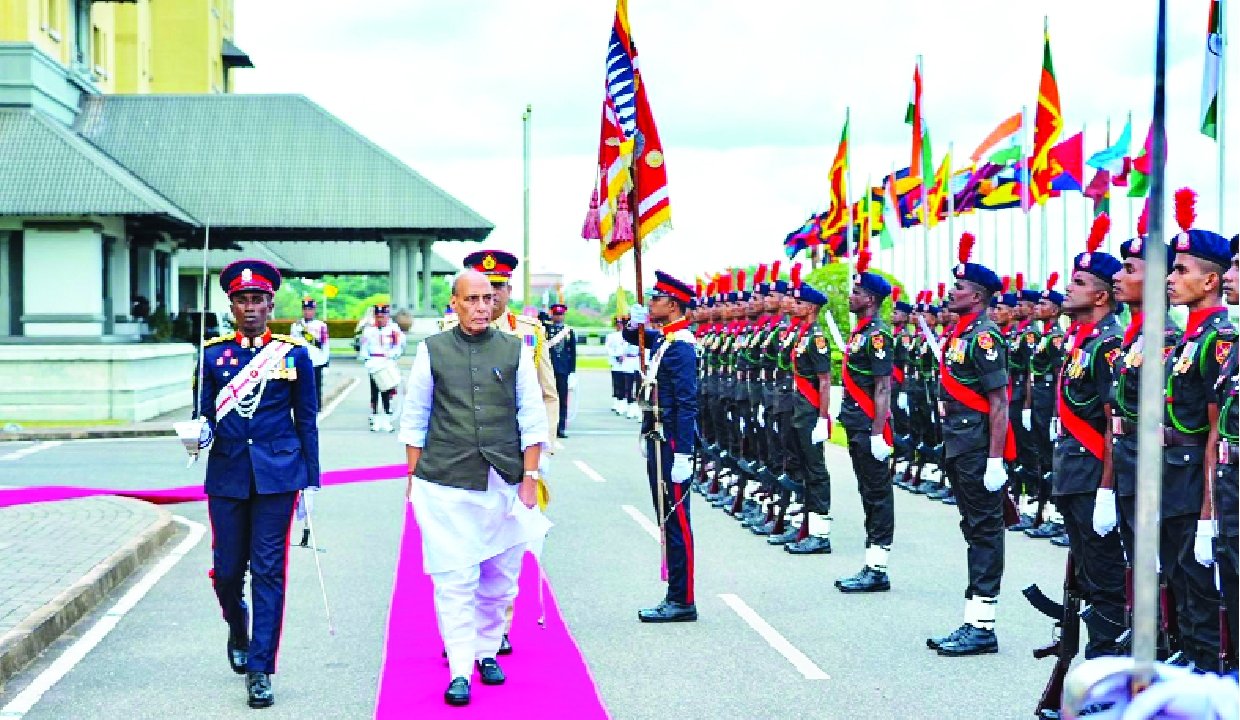
Singh made the remarks at a public event after he held an “extremely productive” meeting with Sri Lankan President Anura Kumara Dissanayake during which they reaffirmed that as civilisational twins, close neighbours and maritime partners, India and Sri Lanka would continue to work jointly to ensure the safety, security, peace and prosperity of the region. Speaking on ‘India-Sri Lanka Maritime Cooperation in the Indian Ocean Region-Civilisational Partners with intertwined destinies’ in Colombo, Singh said that Indian and Sri Lankan ports can become engines of shared economic growth, while their maritime industries can become the drivers for the future prosperity of the region. “Together, India and Sri Lanka are well positioned to serve as the closest partners in safeguarding peace, security and stability across the Indian Ocean Region,” he said.
Singh, who arrived in Colombo on Tuesday for a three-day visit, becoming the first Indian defence minister to visit Sri Lanka in 38 years, said that freedom of navigation and ensuring open trade routes are crucial for the growth and prosperity of the region. “Therefore, secure sea lanes, freedom of navigation, respect for international law, unhindered maritime trade and commerce should remain our pivotal priorities,” he said.
“It is essential that we work together towards shaping a favourable, secure maritime environment, remaining ready to address emerging maritime challenges in the first instance, before they become a serious threat to our developmental interests and the bright future of our region,” he said. Singh said that Sri Lanka occupies a salient strategic location in the Indian Ocean Region, overlooking a vast ocean characterised by crisscrossing busy trade routes. “These routes are not only the arteries for global trade, but also determine the trajectory of our growth and development as well as the safety and security of our region,” he said.
Today, the Indian Ocean is not merely a waterway, but the stage on which the economic and strategic future of our region will be written, he said. “For India and Sri Lanka, both maritime nations bound by this shared ocean, this is not a matter of abstract theory but of lived, everyday reality – one that shapes our trade, our security and our destinies alike,” he said.
Sri Lanka, like India, is undoubtedly central to any strategic discourse on maritime security in the Indian Ocean Region, the minister said. “In Sri Lanka, India sees a friendly neighbour, a longstanding friend and a reliable partner. India-Sri Lanka Maritime Cooperation is thus not only mutually beneficial but quintessential to our collective safety and security,” Singh said.
“In a rapidly changing geopolitical landscape, the Indian Ocean has come to occupy a place of immense contemporary relevance. As emerging economies and fellow democracies, we have a shared future,” he said. Singh said India would be delighted to share its experience and work closely with Sri Lanka for the continued growth and prosperity of the region.